Guide’s PlayhouseMusic · Listening room

Processing · Filters

Listen or Measure. Choose the response.

When you send music to a USB DAC or a Playhouse Connect receiver, you can leave it untouched or let the app upsample it with one filter. Every plot on this page was computed from the filter the app actually runs — not drawn, not borrowed.

Processing is off by default: Original sends the recording’s own samples. Filters apply only to USB Output and Playhouse Connect — not to this device’s built-in speaker or headphones, and not to UPnP.

Choose the output, then one filter

1

Pick the route

USB Output or Playhouse Connect. The local route plays through the system and has no GPH filters.

2

Pick PCM or DSD

PCM up to 705.6 / 768 kHz, staying in the recording’s 44.1 or 48 kHz family. DSD256 over Playhouse Connect; on Mac also USB DoP DSD256 and Native DSD512.

3

Pick from Listen or Measure

Listen holds shapes chosen for listening (minimum, mixed, apodizing, Gaussian, NOS). Measure holds textbook linear-phase references. These are intended uses, not a promise of better sound.

1× and N× are recording slots, not multipliers

1× covers recordings below 50 kHz (44.1 / 48 kHz); N× covers 88.2 kHz and above. You can choose a different filter for each. The output rate is the ceiling you set inside the recording’s clock family — the app never crosses from 44.1 to 48 kHz, and if a design is missing for a rate it says so instead of substituting another filter.

PCM reconstruction filters

Example: a 44.1 kHz recording upsampled 4× to 176.4 kHz — the same case the app’s own filter cards use. Names are exactly as they appear in the app.

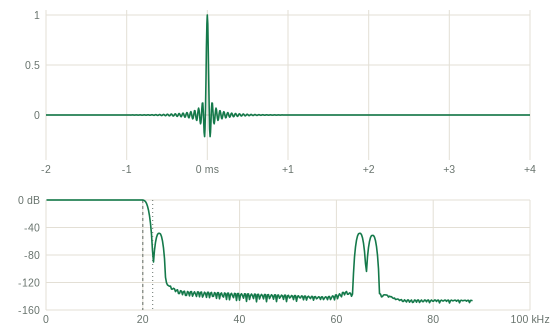
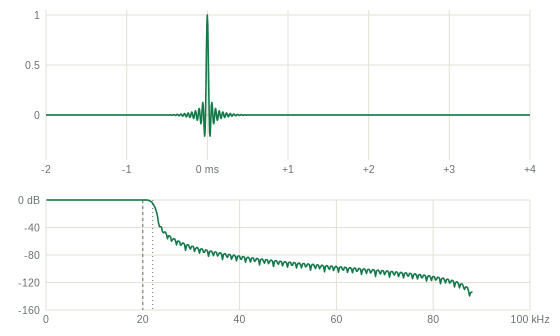
Minimum Phase · Listen 1024

Minimum phase · Development build · Also for DSD
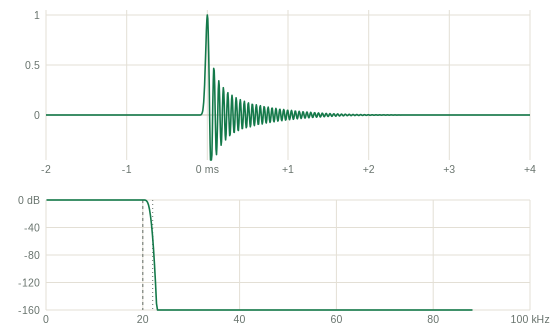
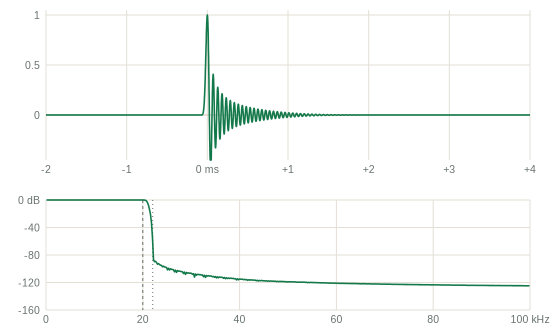
Minimum Phase · Listen 1024: Minimum phase. Impulse response and frequency response on the shared axes described above.

No pre-ringing, flat to 20 kHz, strong image rejection. A long, steep minimum-phase design.

Delay
0.12 ms
At 20 kHz
0.00 dB
Worst image above 22.05 kHz
-65.2 dB
Ringing after peak
2.21 ms
Slots
1×, N×*
Taps
256 / phase · 1024 total

Kernel evidence: evidence/filters/pcm-listen1024.json (exported)

Minimum Phase · Fast Roll-off

Minimum phase · Development build · Also for DSD
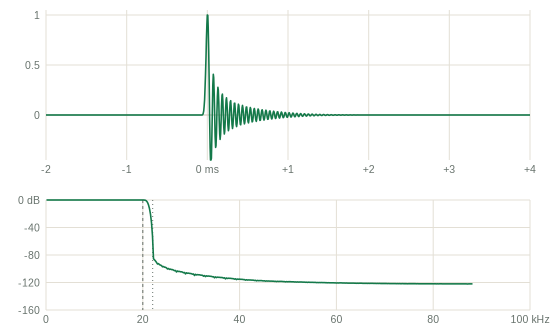
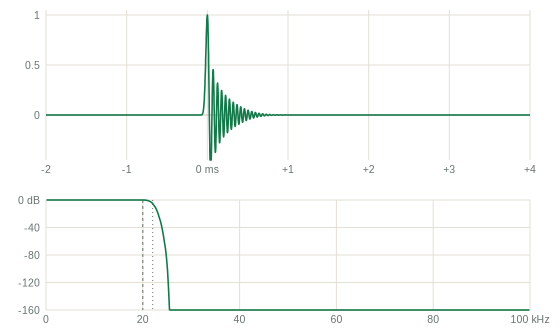
Minimum Phase · Fast Roll-off: Minimum phase. Impulse response and frequency response on the shared axes described above.

Steep cut, all ringing after the transient, about 0.07 ms delay.

Delay
0.07 ms
At 20 kHz
0.00 dB
Worst image above 22.05 kHz
-85.6 dB
Ringing after peak
1.72 ms
Slots
1×, N×
Taps
117 / phase · 468 total

Kernel evidence: evidence/filters/pcm-minimumPhaseFast.json (ran-app-code)

Minimum Phase · Slow Roll-off

Minimum phase · Development build · Also for DSD
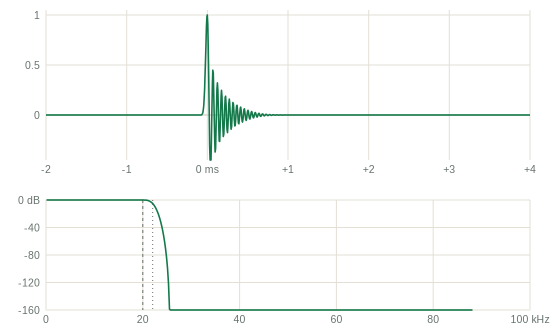
Minimum Phase · Slow Roll-off: Minimum phase. Impulse response and frequency response on the shared axes described above.

Short ringing, but a gentle cut lets ultrasonic images through (−6 dB at the source limit).

Delay
0.10 ms
At 20 kHz
-0.03 dB
Worst image above 22.05 kHz
-6.0 dB
Ringing after peak
0.86 ms
Slots
1×, N×
Taps
71 / phase · 284 total

Kernel evidence: evidence/filters/pcm-minimumPhaseSlow.json (ran-app-code)

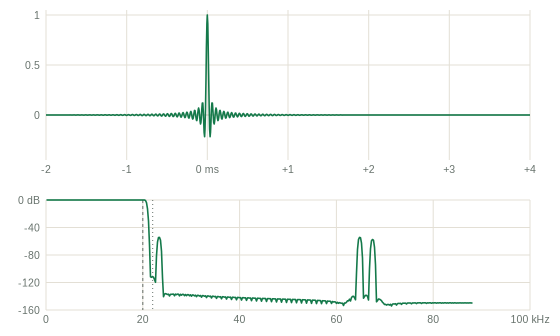
Mixed Phase

Mixed phase · Development build · Also for DSD
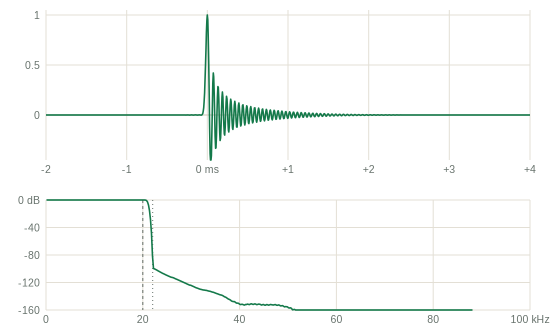
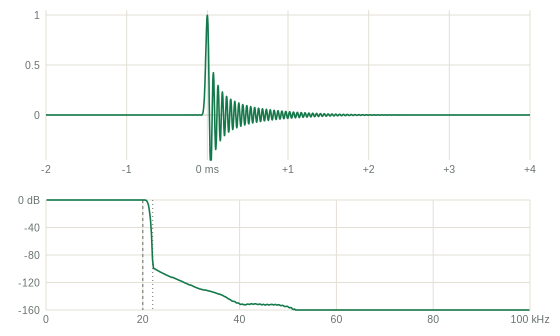
Mixed Phase: Mixed phase. Impulse response and frequency response on the shared axes described above.

A compromise: pre-ringing held below −60 dB, about 1.4 ms delay, steep image rejection.

Delay
1.38 ms
At 20 kHz
0.00 dB
Worst image above 22.05 kHz
-99.6 dB
Ringing after peak
2.21 ms
Slots
1×, N×
Taps
207 / phase · 828 total

Kernel evidence: evidence/filters/pcm-mixedPhase075.json (ran-app-code)

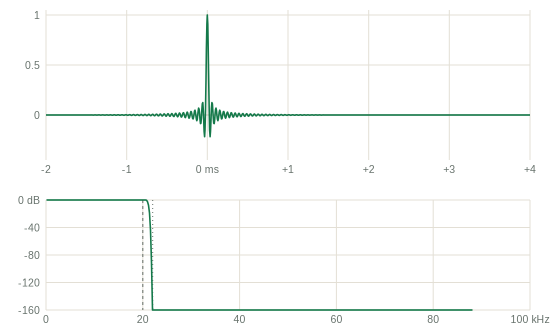
Apodizing · Minimum Phase

Apodizing · minimum phase · Development build · Also for DSD
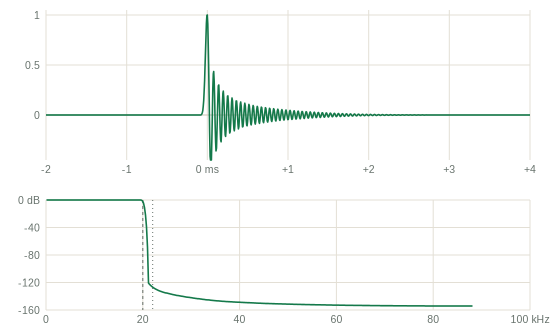
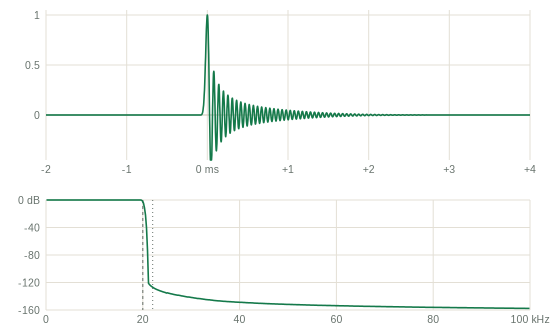
Apodizing · Minimum Phase: Apodizing · minimum phase. Impulse response and frequency response on the shared axes described above.

Cuts before the recording’s limit (−3.7 dB at 20 kHz). Can soften ringing baked into a recording; costs a little treble.

Delay
0.10 ms
At 20 kHz
-3.73 dB
Worst image above 22.05 kHz
-127.7 dB
Ringing after peak
2.49 ms
Slots
1×, N×
Taps
192 / phase · 768 total

Kernel evidence: evidence/filters/pcm-apodizingMinimum.json (ran-app-code)

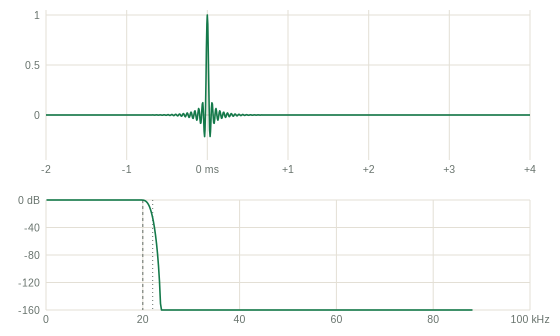
Gaussian · 127

Linear phase · In the 1.1 app · Also for DSD
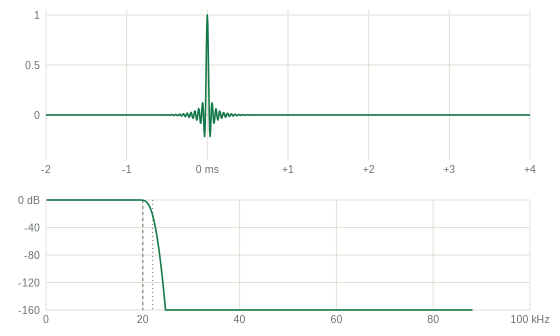
Gaussian · 127: Linear phase. Impulse response and frequency response on the shared axes described above.

Short symmetric ringing; gentle top end, so images at the source limit are only about −26 dB.

Delay
1.44 ms
At 20 kHz
-0.47 dB
Worst image above 22.05 kHz
-25.5 dB
Ringing after peak
0.54 ms
Slots
1×, N×
Taps
127 / phase · 508 total

Kernel evidence: evidence/filters/pcm-gaussian127.json (exported)

Apodizing · Linear Phase

Apodizing · linear phase · Development build
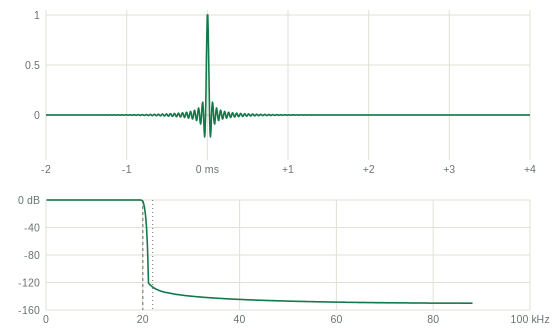
Apodizing · Linear Phase: Apodizing · linear phase. Impulse response and frequency response on the shared axes described above.

Symmetric version of the apodizing cut: −3.7 dB at 20 kHz, strong image rejection, 2.2 ms delay.

Delay
2.17 ms
At 20 kHz
-3.73 dB
Worst image above 22.05 kHz
-127.4 dB
Ringing after peak
1.16 ms
Slots
1×, N×
Taps
192 / phase · 768 total

Kernel evidence: evidence/filters/pcm-apodizingLinear533.json (exported)

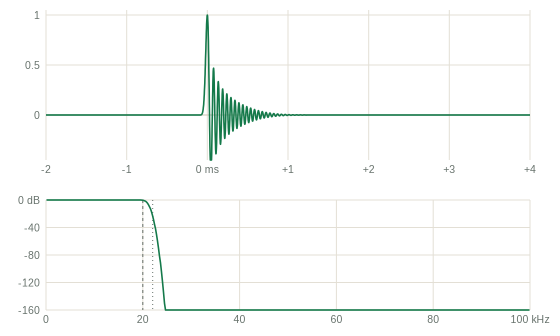
IIR · Classic

IIR · causal · Development build
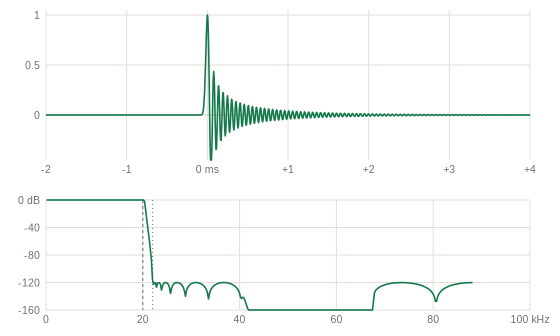
IIR · Classic: IIR · causal. Impulse response and frequency response on the shared axes described above.

Causal, no pre-response; non-linear phase and a long, low tail (about 4 ms above −60 dB).

Delay
0.10 ms
At 20 kHz
0.00 dB
Worst image above 22.05 kHz
-120.2 dB
Ringing after peak
4.19 ms
Slots
1×, N×
Taps
—

Kernel evidence: evidence/filters/pcm-iir533.json (ran-app-code)

IIR2 · Sharp

IIR · causal · Development build
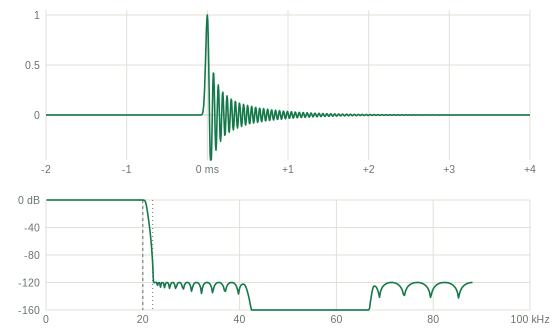
IIR2 · Sharp: IIR · causal. Impulse response and frequency response on the shared axes described above.

A sharper IIR: shorter tail than Classic (about 2.7 ms), still no pre-response.

Delay
0.10 ms
At 20 kHz
-0.06 dB
Worst image above 22.05 kHz
-119.5 dB
Ringing after peak
2.73 ms
Slots
1×, N×
Taps
—

Kernel evidence: evidence/filters/pcm-iir2_533.json (ran-app-code)

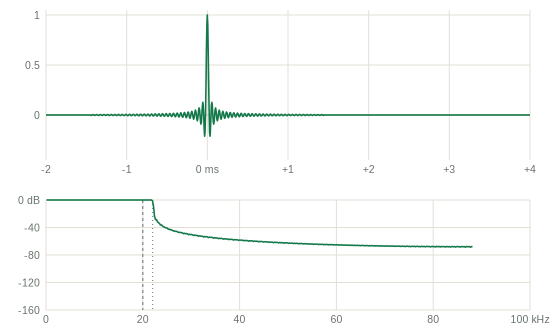
Cosine Interpolation

Short interpolator · Development build
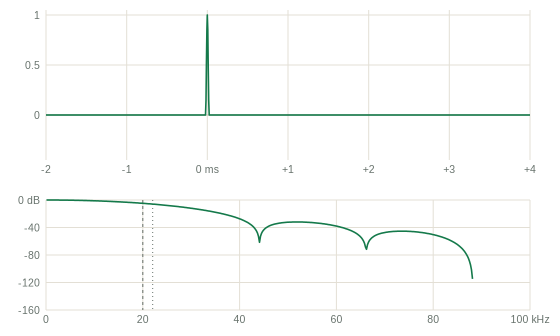
Cosine Interpolation: Short interpolator. Impulse response and frequency response on the shared axes described above.

Almost no ringing, but clear treble droop (about −1 dB at 10 kHz, −5 dB at 20 kHz) and weak image rejection.

Delay
0.02 ms
At 20 kHz
-4.88 dB
Worst image above 22.05 kHz
-6.0 dB
Ringing after peak
0.00 ms
Slots
1×, N×
Taps
3 / phase · 12 total

Kernel evidence: evidence/filters/pcm-cosine533.json (exported)

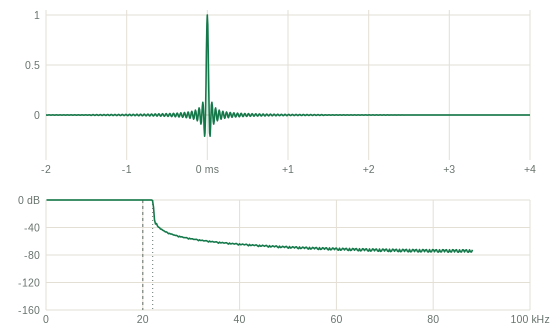
Cubic Hermite

Short interpolator · Development build
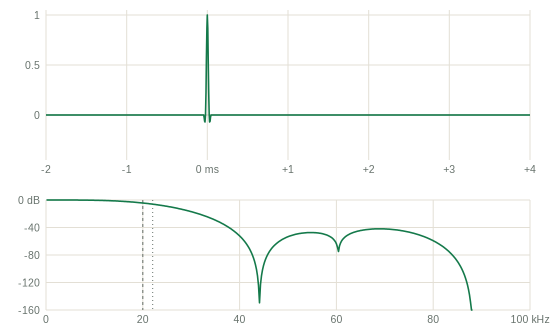
Cubic Hermite: Short interpolator. Impulse response and frequency response on the shared axes described above.

Similar to Cosine with a touch less droop (−4.4 dB at 20 kHz); images barely reduced.

Delay
0.05 ms
At 20 kHz
-4.43 dB
Worst image above 22.05 kHz
-6.1 dB
Ringing after peak
0.02 ms
Slots
1×, N×
Taps
5 / phase · 20 total

Kernel evidence: evidence/filters/pcm-cubic533.json (exported)

NOS · App Bypass

No app filter · Development build

The app does nothing for that recording: no resampling, dither or word-length change. Reconstruction is left to your DAC’s own filter, which we can’t see — so there is no plot. This is not the DAC’s NOS mode.

* Listen 1024 has no design for 352.8 / 384 kHz recordings.

Linear Phase · 128

Linear phase · In the 1.1 app

Linear Phase · 128: Linear phase. Impulse response and frequency response on the shared axes described above.

Textbook symmetric response, 1.5 ms delay. Worst image only about −48 dB (near 65 kHz).

Delay
1.45 ms
At 20 kHz
-0.22 dB
Worst image above 22.05 kHz
-48.4 dB
Ringing after peak
0.81 ms
Slots
1×, N×
Taps
128 / phase · 512 total

Kernel evidence: evidence/filters/pcm-linear.json (ran-app-code)

Linear Phase · 256

Linear phase · In the 1.1 app

Linear Phase · 256: Linear phase. Impulse response and frequency response on the shared axes described above.

Longer version of Linear 128: flat to 20 kHz, images about −54 dB, 2.9 ms delay. Listed under Compatibility.

Delay
2.90 ms
At 20 kHz
0.00 dB
Worst image above 22.05 kHz
-54.5 dB
Ringing after peak
1.46 ms
Slots
1×, N×
Taps
256 / phase · 1024 total

Kernel evidence: evidence/filters/pcm-extended.json (ran-app-code)

Linear Phase · 117

Linear phase · In the 1.1 app

Linear Phase · 117: Linear phase. Impulse response and frequency response on the shared axes described above.

Default reference for 44.1/48 kHz recordings: short ringing (0.58 ms), but images about −30 dB at the source limit.

Delay
1.33 ms
At 20 kHz
-0.29 dB
Worst image above 22.05 kHz
-29.8 dB
Ringing after peak
0.58 ms
Slots
1× only
Taps
117 / phase · 468 total

Kernel evidence: evidence/filters/pcm-linear117.json (exported)

Linear Phase · 511

Linear phase · In the 1.1 app

Linear Phase · 511: Linear phase. Impulse response and frequency response on the shared axes described above.

Default reference for high-rate recordings: exactly symmetric, extremely deep stopband, 5.8 ms delay.

Delay
5.79 ms
At 20 kHz
0.00 dB
Worst image above 22.05 kHz
-267.4 dB
Ringing after peak
1.28 ms
Slots
N× only
Taps
511 / phase · 2044 total

Kernel evidence: evidence/filters/pcm-detail511.json (ran-app-code)

Lanczos · 23 Zero Crossings

Linear phase · Development build

Lanczos · 23 Zero Crossings: Linear phase. Impulse response and frequency response on the shared axes described above.

Lanczos window, 23 zero crossings: short symmetric ringing, gentle top, images through at −6 dB at the limit.

Delay
0.52 ms
At 20 kHz
0.01 dB
Worst image above 22.05 kHz
-6.0 dB
Ringing after peak
0.46 ms
Slots
1×, N×
Taps
47 / phase · 188 total

Kernel evidence: evidence/filters/pcm-lanczos533.json (exported)

FFT · Fast

Block FFT · Development build

FFT · Fast: Block FFT. Impulse response and frequency response on the shared axes described above.

Block FFT: the response depends on where a transient falls in a block (plot shows the stream-start impulse).

Delay
1.45 ms
At 20 kHz
-0.12 dB
Worst image above 22.05 kHz
-6.0 dB
Ringing after peak
1.43 ms
Slots
1×, N×
Taps
—

Kernel evidence: evidence/filters/pcm-fftFast533.json (ran-app-code)

FFT · Overlap

Block FFT · Development build

FFT · Overlap: Block FFT. Impulse response and frequency response on the shared axes described above.

FFT with 75 % overlap: smoother than Fast, still block-dependent and with block latency.

Delay
2.90 ms
At 20 kHz
-0.06 dB
Worst image above 22.05 kHz
-6.0 dB
Ringing after peak
1.99 ms
Slots
1×, N×
Taps
—

Kernel evidence: evidence/filters/pcm-fftOverlap533.json (ran-app-code)

Reading the plots

Top: impulse response

What a single click becomes. Time runs from 2 ms before the main peak to 4 ms after; height is relative to the peak. Ripples before 0 are pre-ringing, ripples after are post-ringing.

Bottom: frequency response

Level from 0 to 100 kHz, 0 to −160 dB. The dashed line marks 20 kHz, the dotted line the 22.05 kHz limit of a 44.1 kHz recording. Anything above the dotted line that isn’t at the floor is an image the filter let through.

Same scales everywhere

Every PCM and DSD plot uses identical axes, so shapes can be compared directly. PCM curves end at 88.2 kHz, the limit of the 176.4 kHz output.

Calculations, not measurements

Digital filter calculations from the app’s own tables and code. Not a USB capture, not a DAC output, not an analogue measurement.

PCM noise control

All processing runs in 64-bit floating point. The result is delivered to your DAC as 16, 20 or 24-bit PCM (default 20-bit), carried in a 32-bit word. The 32-bit word is the container, not the precision of your DAC.

Off

Rounds to the chosen word length. No dither.

Playhouse Triangular

Triangular (TPDF) dither of ±1 LSB: turns rounding error into steady, signal-independent noise.

Playhouse Serenade 15 · default

TPDF dither plus 15-stage noise shaping, moving the noise away from the most sensitive part of the audible band.

DSD: one direct filter, then the modulator

For DSD output the app takes the recording straight to the DSD rate with a single FIR filter, applies peak protection, then converts to 1-bit with the Playhouse Pulse 5 Pro modulator. Full-scale PCM maps to 50 % modulation (−6 dB, the SACD reference) — level-match before comparing with PCM.

DSD256 over Playhouse Connect on iPhone, iPad and Mac. On Mac also USB DoP DSD256, and Native DSD512 on the reviewed Audalytic DR70. iPhone and iPad USB Output is PCM only — no USB DSD and no DSD512 on iOS. Plots show 44.1 kHz → DSD256; the DSD512 versions are the same designs at twice the rate.

Minimum Phase · Listen Single Stage

Minimum phase · Development build

Minimum Phase · Listen Single Stage: Minimum phase. Impulse response and frequency response on the shared axes described above.

The Gaussian · Short response made minimum phase: no pre-ringing, short post-ringing, gentle top end.

Delay
0.12 ms
At 20 kHz
-0.46 dB
Worst image above 22.05 kHz
-25.9 dB
Ringing after peak
1.13 ms
Slots
DSD256 · DSD512 (Mac)
Taps
128 / phase · 32768 total

Kernel evidence: evidence/filters/dsd256-listenSingleStage.json (exported)

Minimum Phase · Fast Roll-off

Minimum phase · Development build

Minimum Phase · Fast Roll-off: Minimum phase. Impulse response and frequency response on the shared axes described above.

Steep cut, all ringing after the transient, about 0.07 ms delay.

Delay
0.07 ms
At 20 kHz
0.00 dB
Worst image above 22.05 kHz
-85.8 dB
Ringing after peak
1.72 ms
Slots
DSD256 · DSD512 (Mac)
Taps
117 / phase · 29952 total

Kernel evidence: evidence/filters/dsd256-minimumFast.json (exported)

Minimum Phase · Slow Roll-off

Minimum phase · Development build

Minimum Phase · Slow Roll-off: Minimum phase. Impulse response and frequency response on the shared axes described above.

Short ringing, but a gentle cut lets ultrasonic images through (−6 dB at the source limit).

Delay
0.10 ms
At 20 kHz
-0.03 dB
Worst image above 22.05 kHz
-6.0 dB
Ringing after peak
0.87 ms
Slots
DSD256 · DSD512 (Mac)
Taps
71 / phase · 18176 total

Kernel evidence: evidence/filters/dsd256-minimumSlow.json (exported)

Mixed Phase

Mixed phase · Development build

Mixed Phase: Mixed phase. Impulse response and frequency response on the shared axes described above.

A compromise: pre-ringing held below −60 dB, about 1.4 ms delay, steep image rejection.

Delay
1.38 ms
At 20 kHz
0.00 dB
Worst image above 22.05 kHz
-99.4 dB
Ringing after peak
2.21 ms
Slots
DSD256 · DSD512 (Mac)
Taps
207 / phase · 52992 total

Kernel evidence: evidence/filters/dsd256-mixedPhase.json (exported)

Apodizing · Minimum Phase

Apodizing · minimum phase · Development build

Apodizing · Minimum Phase: Apodizing · minimum phase. Impulse response and frequency response on the shared axes described above.

Cuts before the recording’s limit (−3.7 dB at 20 kHz). Can soften ringing baked into a recording; costs a little treble.

Delay
0.10 ms
At 20 kHz
-3.73 dB
Worst image above 22.05 kHz
-127.7 dB
Ringing after peak
2.52 ms
Slots
DSD256 · DSD512 (Mac)
Taps
192 / phase · 49152 total

Kernel evidence: evidence/filters/dsd256-apodizingMinimum.json (exported)

Gaussian · Short

Linear phase · Development build

Gaussian · Short: Linear phase. Impulse response and frequency response on the shared axes described above.

Exactly symmetric with short ringing; a gentle top end lets some energy above 22 kHz through to the modulator.

Delay
1.45 ms
At 20 kHz
-0.45 dB
Worst image above 22.05 kHz
-25.9 dB
Ringing after peak
0.54 ms
Slots
DSD256 · DSD512 (Mac)
Taps
128 / phase · 32768 total

Kernel evidence: evidence/filters/dsd256-gaussian.json (exported)

Linear Phase · Long

Linear phase · Development build

Linear Phase · Long: Linear phase. Impulse response and frequency response on the shared axes described above.

The measuring reference for DSD: exactly symmetric, flat to 20 kHz, images about 142 dB down, 2.3 ms delay.

Delay
2.35 ms
At 20 kHz
0.00 dB
Worst image above 22.05 kHz
-141.9 dB
Ringing after peak
1.11 ms
Slots
DSD256 · DSD512 (Mac)
Taps
207 / phase · 52992 total

Kernel evidence: evidence/filters/dsd256-linearLong.json (exported)

Compatibility DSD filters

These older filters first use Apple’s system converter to reach 352.8 / 384 kHz, then a second FIR stage to DSD. Apple’s converter coefficients aren’t available, so an honest end-to-end plot can’t be drawn; we list them without one.

NamePhaseStage 2 taps
Minimum Phase · 255Minimum phase255 / phase
Gaussian 127Linear phase ≈127 / phase
Gaussian 255Linear phase ≈255 / phase
Gaussian 511Linear phase ≈511 / phase
Linear · Wide guard 255Linear phase ≈255 / phase
Halfband 451Linear phase ≈451 / phase
Halfband 191Linear phase ≈191 / phase

What to expect when you listen

Expected from the design · not yet confirmed by listening

Linear vs minimum phase

Linear phase delays every frequency equally and rings symmetrically around a transient. Minimum phase puts all ringing after it and adds a little phase shift near 20 kHz. The ringing in both sits at the cutoff, around 20–22 kHz.

Steep vs gentle

A steep cut keeps 20 kHz flat and removes ultrasonic images but rings longer. A gentle cut rings less but lets images through, which some amplifiers and tweeters may not like.

Most likely to be audible

The treble droop of Cosine and Cubic (about 1 dB at 10 kHz), and apodizing’s −3.7 dB at 20 kHz for listeners who still hear that high. Differences between the steep filters are expected to be subtle at most.

Pre-ringing

“No pre-ringing” is a property of the design, not a guaranteed improvement. Evidence that pre-ringing at 20 kHz is audible on music is weak.

What has been checked — and what hasn’t

  • The plotted kernels were exported from the app’s bundled tables or produced by running the app’s own filter code on a single test pulse; for every filter, the app’s streaming code reproduces the table to within 1 part in 10¹⁴, and table hashes match the installed development build 53302.
  • Development build 53302 is installed on the owner’s iPhone and Mac; iPad has been checked in Simulator only. Filters marked “In the 1.1 app” are also in the 1.1 source; the rest are development-build only.
  • None of the filters has been confirmed by listening yet. Sound descriptions are expectations from the design, not listening results.
  • GPH designs. No HQPlayer code or coefficient tables are used, and none were recovered. Some design parameters were informed by analysis of other players; we don’t claim identical output or sound to any of them.

See where filters sit in the Signal Path